.png)

.png)
The Involved Talks series is primarily meant for our team to learn from our clients and to share insights and highlights with you. But we also enjoy having conversations with people whose work is inspiring and energizing, even if we haven’t had the pleasure of working with them yet.
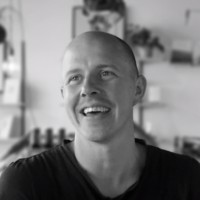
On this occasion, we had a chance to talk with Christopher Klüter, who works as Program Manager at the Alliance of Democracies, an international foundation based in Copenhagen that leads pro-democracy initiatives around the world — from global summits to start-up support in frontline democracies — using a bottom-up, local-first approach.
The following are four specific moments of our conversation that helped us understand how he conceives involvement, and what challenges, breakthroughs and perspectives have encouraged him to keep betting on democratic change.
1 – From founder to program manager
Before stepping into the geopolitical arena through the Alliance of Democracies, Christopher founded HackYourFuture in Denmark, a coding school for refugees and asylum seekers designed to help them integrate not just into the labor market but to feel a sense of purpose and belonging. The concept originated in the Netherlands, and Christopher came across it right in a moment of crisis and change.
“My educational background is from a business school, where I got trained to be like a middle person between arts and business. I had a lot of passion for it. But in 2016, when Brexit happened, and then Trump got elected, it felt like a rude awakening. I remember sitting there in my mid‑20s, working on animated films and TV shows — it was a very fun job — but I started asking myself: am I spending my time correctly? How much impact can this really have on the causes I care about?
Christopher’s shift is one we’ve seen more often in recent years: young people with promising careers in creative or corporate fields decide to reorient their work toward systems that feel more urgent and under-resourced. His path was also sharpened by his personal experience with exclusion: both as an expat and as a facilitator of change.
2 – The spectrum of exclusion
Even after years of speaking fluent Danish, Christopher still gets asked where he’s really from. “It’s just a small accent,” he shares, “but sometimes you’re at a wedding and wish people didn’t switch to English or ask again about your background.” For him, these moments aren’t dramatic—but they accumulate. These signals, subtle but persistent, undermine your confidence to belong. And if that happens to someone already integrated, what happens to those who are still on the outside looking in?
“Once, we ran a session at a refugee camp on the outer border of Europe in Greece. Although we thought we were prepared for low levels of tech literacy, we were still surprised to meet people that have never used email. I’d try to explain what an email account is—why you log in, log out, how messages live inside it—but some people would just make a new account every time they wanted to send an email, and then never understand why no one replied. At the end of the day, this experience gave us a positive yet tough lesson.”
We’ve experienced similar moments at Involved: the degree of digital literacy and the risk of excluding people around us is much trickier and nuanced than we tend to assume. Which is also what we learnt to appreciate about HackYourFuture in this conversation: how they built a platform, but also a framework that tackles the temptation of exclusion.
3 – Mindful design & risk-taking to enable involvement
When we asked Christopher how HackYourFuture tackled exclusion, he pointed to the ECHO framework — Exposure, Community, and Hands-On. It was originally conceptualized for a grant application, however it became a creative way to nudge behavior. Exposure meant showing how real professionals work, not just telling. Community meant removing hierarchy by mixing volunteers and trainees from day one. And Hands-On meant skipping theory and jumping straight into real tools and tasks.
“We did a lot of work upfront to make the transition easier — not just into jobs, but into relationships. Companies could commit more easily to internships or employment because our bootcamp and community had mimicked startup environments. We avoided a two-tier setup by mixing volunteers and trainees from the start. It helped people see how professionals think and talk, and even among trainees, it made it okay to ask questions and not know everything.”
But mindfulness may not be enough, unless there is enough risk-taking energy among stakeholders. In Christopher’s experience working at the Alliance of Democracies, that type of energy is more abundant when the threat of massive exclusion is dangerous. “In places like Ukraine, Moldova, or Georgia, there’s a stronger appetite for trying new things. The threat feels real, so people are more open to just going for it — not overthinking, just acting. That kind of urgency creates a really powerful space for innovation”.
Finding your place on the spectrum of exclusion matters. Not everyone can—or should—tackle exclusion at every level. What stood out in our talk with Christopher was how important it is to find the part of the spectrum that speaks to you most, and stay committed there. In the final part of our conversation, he shared where he believes more radical inclusion is still urgently needed.
4 – Radical inclusion, but where?
As our conversation wound down, we asked Christopher where he would most like to see radical inclusion — not just more access or softer barriers, but full-force, urgent involvement of people who are typically left out.
He didn’t hesitate: translation and language technology. “I’ve always wondered why we haven’t come further with translation,” he said. “There’s so much to be gained if you could just have this Star Trek-type universal translator.” But he was quick to add that it’s not just about convenience. It’s about culture, memory, and equity: “There’s maybe a dialect or a language spoken somewhere by only 40 people… Who’s going to bring that into Google Translate? Who’s going to build the language model behind that?”
He also brought the conversation closer to home. At Alliance of Democracies, he sees that “maybe we need more radical inclusion of youth in democratic processes, because that’s definitely a demographic that’s understandably alienated by a system that feels inaccessible, corrupt, and just totally out of your control.” Some transparency tools exist, he noted, but we still need more daring innovators to make democracy feel tangible, accessible — even catchy — especially for younger generations. “There’s a lot,” he added, “and it could definitely benefit from more bright minds and good actors in it.”
Final reflection
What stayed with us after this conversation wasn’t just the clarity of Christopher’s answers, but also the consistency of his practice. From founding a coding school for displaced people to supporting start-ups in frontline democracies, his work reflects a steady belief: involvement isn’t something you “grant” to others. It’s something you build into systems — sometimes subtly, sometimes urgently — until participation becomes part of how things work.
We were also reminded how exclusion isn’t just a political issue. It’s a design issue. A relational issue. A question of who feels spoken to, who gets to speak back, and what happens when that loop breaks or never begins.
These talks are a way for us at Involved to keep sharpening our thinking; not just about tools or facilitation, but about what it means to create spaces where people can show up fully. Christopher’s insights helped us see that with more depth.
What would it take to make the spaces you’re part of a little more radically inclusive?